Bastion & Web Terminal
The bastion gives you a browser terminal to any managed device, with the access decisions, recording and audit trail that make it usable in a regulated environment.
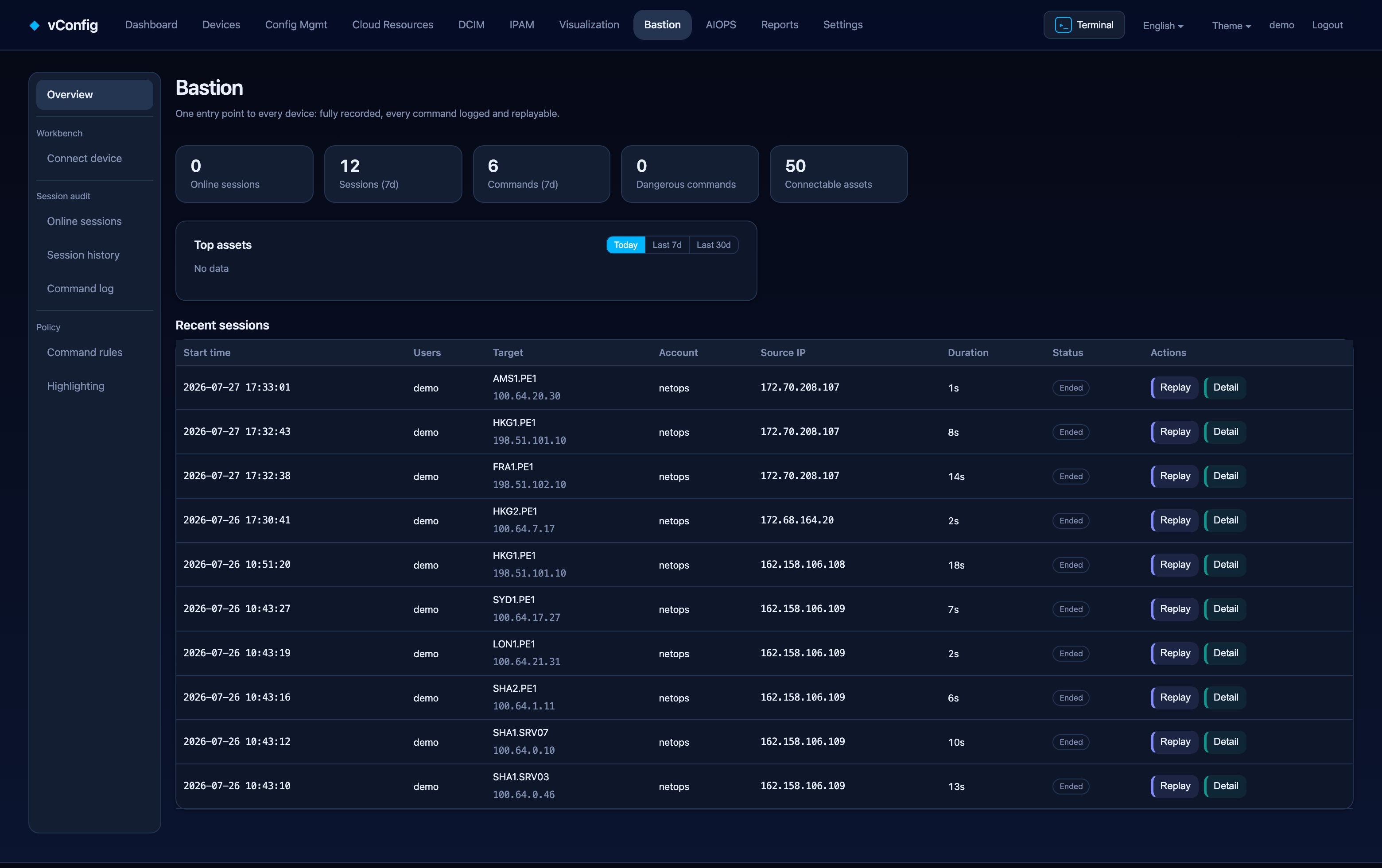
Layout
The left-hand navigation is grouped by what you are there to do:
| Group | Page | Purpose |
|---|---|---|
| Overview | Online sessions, sessions and commands over 7 days, dangerous commands, connectable assets, top assets and recent sessions | |
| Workbench | Connect device | Pick a device and open a session |
| Session audit | Online sessions | Who is connected right now; administrators can cut a session |
| Session history | Past sessions, each with Replay and Detail | |
| Command log | Every command typed, searchable across sessions | |
| Policy | Command rules | What is blocked or flagged |
| Highlighting | Terms to highlight in live and replayed sessions |
The recent-sessions table records start time, user, target device and its IP, the account used, source IP, duration and status. Source IP is the one people forget to log and the one an auditor always asks for.
Credentials
The bastion uses the same two-layer credential model as everything else — per-device credentials, else global. There is also a use my own account mode, where the password you typed at web login is used to log into the device, so per-engineer accounts on network devices stay per-engineer through the bastion.
Recording and replay
Sessions are recorded and replayable, and every command is indexed separately. During a postmortem "what did we type on that box" is a search, not an interview.
Command rules
Command rules block or flag commands at the bastion, independently of device-side authorisation. This catches the fat-finger reload on the box whose AAA is misconfigured — which is exactly the box where it matters.
Out-of-band
The bastion also fronts out-of-band console access, so the console path gets the same recording and permissions as SSH. When the production path is down, the audit trail should not go down with it.
Architecture note
The session proxy runs as a separate gateway process, not inside the web application. Long-lived terminal connections must not occupy application workers — that is a reliability property, not an optimisation. The gateway's public port is configurable so it can sit behind a reverse proxy on 443 where cloud security groups only allow 80 and 443.